The storm had been building all afternoon. Mara stood on the cliff path with the wind pulling at her coat, watching the water below gather itself — the way it always did, patient and then suddenly not. Her grandmother had called this part of the coast the long argument: the sea forever making its case against the rock, the rock forever answering, “Not yet.”
Mara had come here every year since she was nine, when her grandmother first pressed a postcard of a famous wave into her palm — the one by the Japanese master, claws of foam reaching over drowning boats — and said, “People think that wave is about danger. It’s about timing. Everything is about timing.”
The Oldest Rhythm on Earth
Long before anyone painted a wave, the waves were already painting. They are the planet’s original drummers, keeping time in a band that started 3.8 billion years ago, when the first oceans formed and began their slow, ceaseless argument with the land. Every coastline you have ever loved is a draft the sea rewrote a thousand times. The cliffs of Dover, the coves of Big Sur, the basalt columns of the Giant’s Causeway — all of them are the sea’s rough drafts, crossed out and redrawn in foam.
Artists have been trying to catch that rhythm since hands first learned to hold charcoal. The Minoans spiraled it onto pottery four thousand years ago. Chinese ink painters of the Song dynasty let it bloom across silk in a single breath of the brush. And then there is the shadow under which every wave painting since has stood: Katsushika Hokusai, whose Great Wave off Kanagawa (1831) turned a breaking wave into perhaps the most recognizable image in all of art — nature as a living claw, beautiful and indifferent all at once.
Where Hokusai’s Shadow Meets a Modern Hand
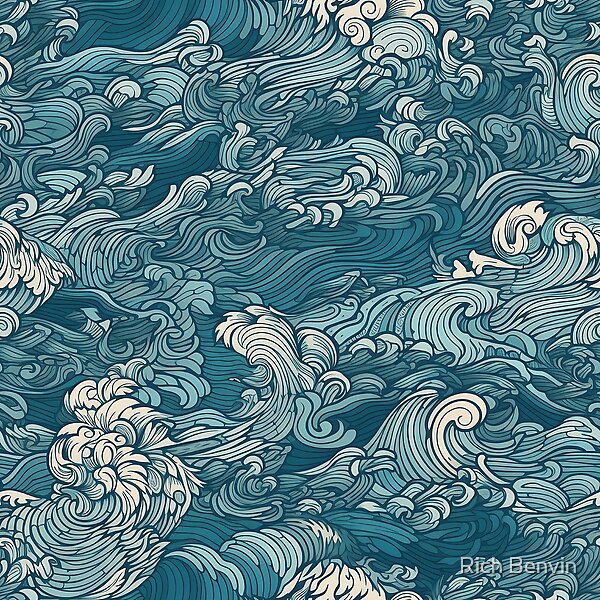
Crashing Waves stands in that long lineage but speaks in its own accent. Where Hokusai’s hand was the crisp, disciplined edge of the woodblock — every line carved, every contour deliberate — this piece loosens the grip. The breakers here are painterly: swirling teal currents in mid-teal (#14667A) and breaker blue (#0A4A5C), foam crests rendered in foam ivory (#E9E3D2) that look lifted by an actual gust. You can feel the brush moving. It is a wave caught not at the moment of the photograph but at the moment of the memory — the way a wave looks when you close your eyes at the shore and the salt is still in your hair.
The sea never asks permission — it simply arrives, again and again, and rewrites the shore.
Resilience, Painted in Teal
Mara’s grandmother used to say the sea was the best teacher of the only lesson that mattered: every crash is also a return. A wave spends itself completely against the rock — and then, impossibly, it comes back. It always comes back. Not bitter. Not diminished. Just water, again, doing what water does.
That is the meaning woven into this design, and why it belongs on the wall of anyone who has ever had to start over. The deep ocean ink (#07303F) at its depths gives it gravity — this is not a postcard wave, not decoration for people who think the ocean is scenery. It is dramatic. But the seafoam (#5E9CA3) keeps it calm enough to live with, morning after morning, in a bedroom or a study or the corner of a kitchen where the light comes in sideways. It is the kind of art that does not just hang there; it breathes.
Bringing the Tide Indoors
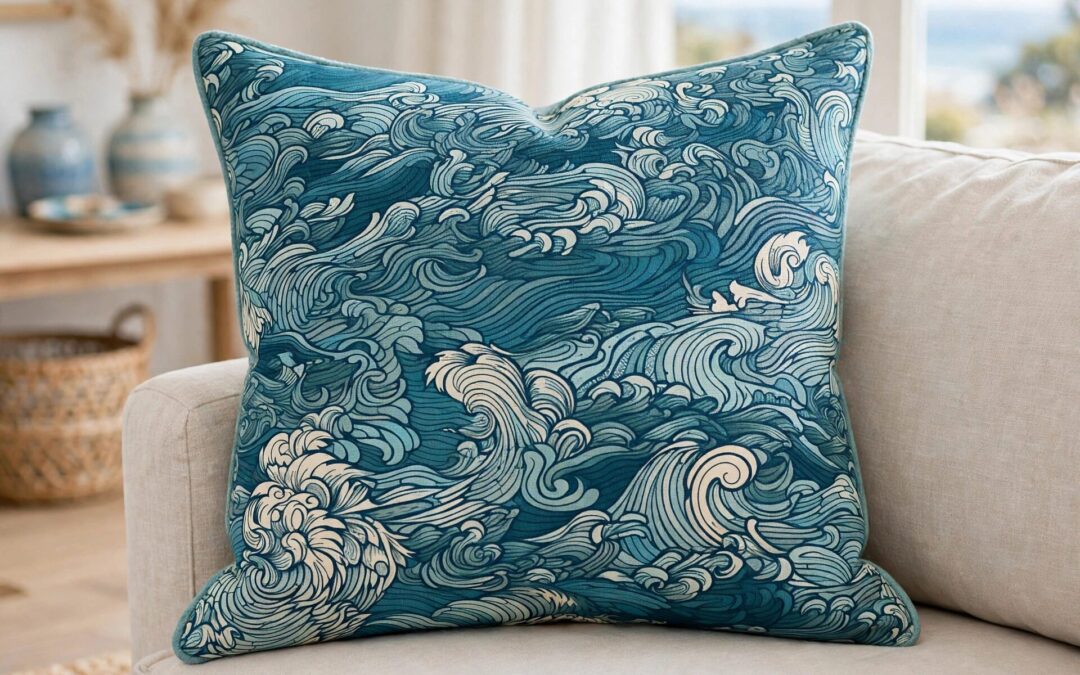
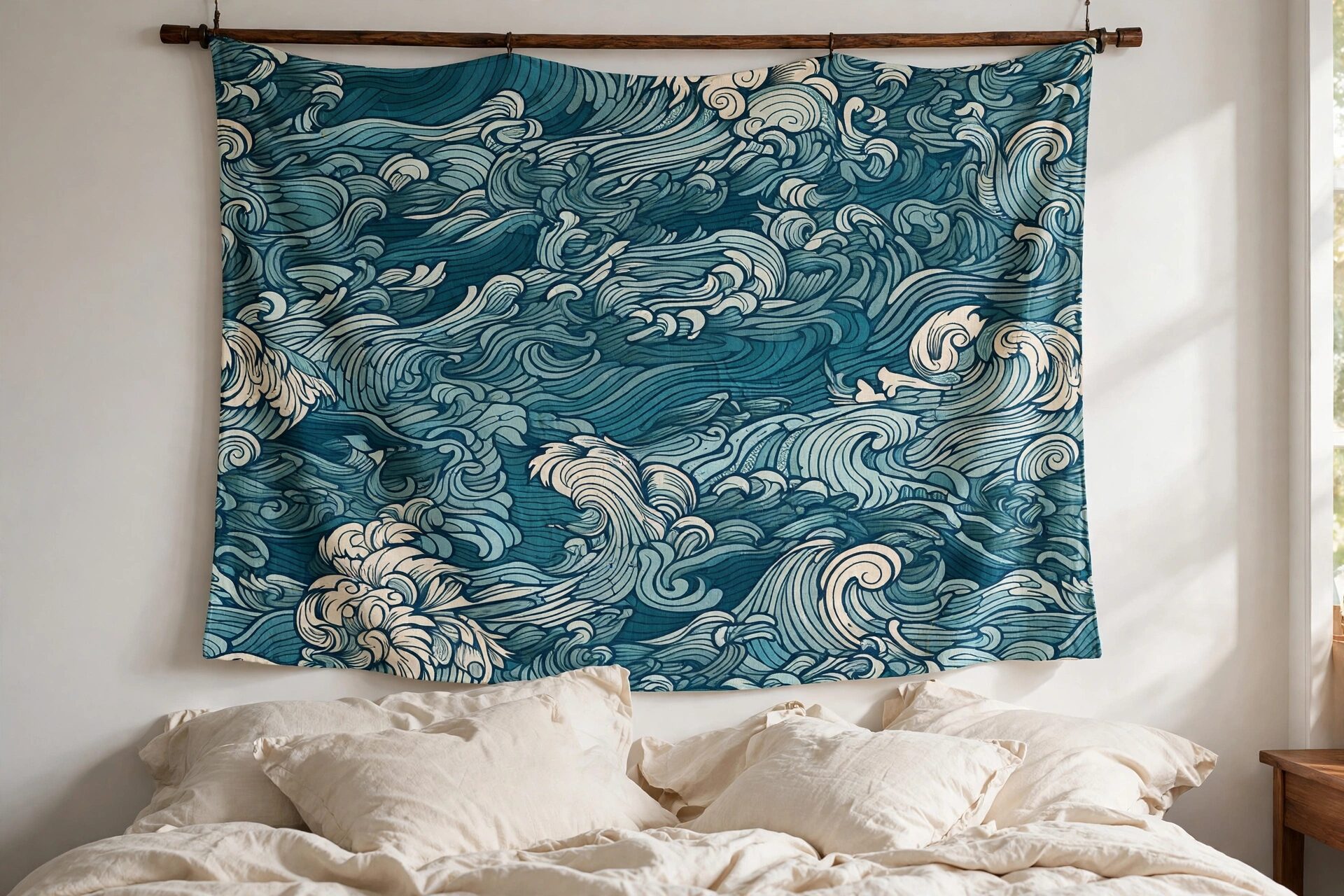
A design like this was made to live large. On a wall tapestry, the full swirl of the breakers can run wall-to-wall — a whole sea above your bed, and no one has to sleep through a storm to have one. On a throw pillow, it becomes something you can lean into: the one object on your sofa that looks like it has somewhere urgent to be. The pattern repeats cleanly enough to carry across a duvet cover or a shower curtain, turning the most ordinary rooms — the bath, the guest bedroom — into places with weather in them.
And because the palette holds its depth without shouting, it travels well beyond the coastal look. Pair it with driftwood and linen for the beach-house reading nook, or set it against charcoal furniture and brass lamps for a study that feels like the cabin of a ship. It is nautical without being kitsch, dramatic without being loud — the founding designs of the Hashola shop were chosen for exactly this kind of staying power.
Mara stayed on the cliff until the light went flat. The storm never quite broke — the waves kept rehearsing, pulling back, returning. On the bus home she looked at her grandmother’s postcard again, the paper soft at the edges now, and thought: the wave in the picture never finishes. That’s the point. It never has to.
The Sea Is Waiting — Bring It Home
Some art you buy because it matches the sofa. Some you buy because it matches the life you’re trying to live — the one where you keep showing up, keep returning, keep arriving again and again like the tide. Crashing Waves is the second kind.
Find it on throw pillows, wall tapestries, duvet covers, shower curtains, tote bags, and dozens more — visit the Crashing Waves artwork page or browse the full collection at the Hashola Designs shop on RedBubble. The sea never asks permission. Neither should your walls.