Breathe in. Picture the sunflower as you have always known it: the good citizen of the garden, the tall yellow friend leaning over the fence, face turned faithfully toward the light. Breathe out. Now let that image go. Because there is another sunflower — the one that appears in late August, when the heat has stopped being pleasant and started being personal — and it does not follow the sun at all.
It becomes it.
On Solar Worship
Every sunflower is a small act of devotion. The young ones practice heliotropism — tracking the sun across the sky from east to west, a slow green prayer repeated daily — until maturity fixes their faces eastward, toward the dawn, as if they have finally learned what they were looking for. The French call it tournesol, the turn-sun. The Italians, girasole. Every language that has met this flower has named it for the same impossible ambition: to face the light and never look away.
But devotion, practiced long enough, changes the devotee. That is the meditation at the heart of Sunflowers on Fire. What happens when the worshipper stops kneeling and stands up? When the flower stops borrowing the sun’s fire and generates its own?
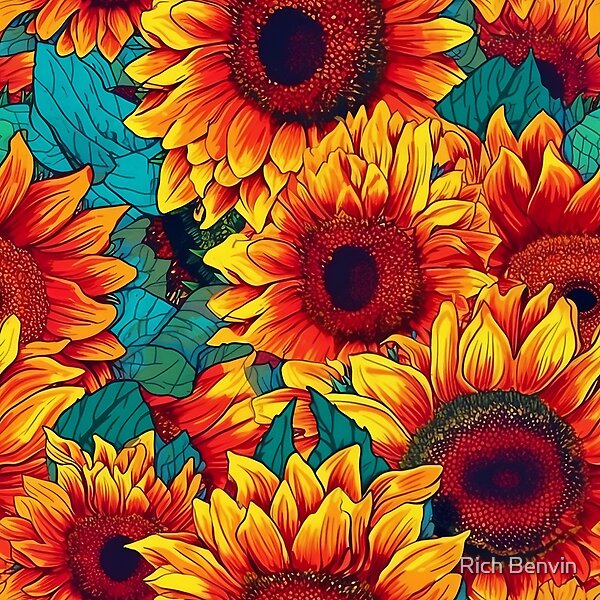
Look at the blooms: blaze red (#D6281C) deepening into burnt sienna (#7A2A12) at the seed-dark hearts (#1A1210), ember orange (#FF7B1C) licking outward into golden yellow (#FFC82E) — petals that read less like flower parts and more like flame caught in the act of being a flower. And then, the masterstroke: the leaves rendered in cool teal (#0F6E6B), a temperature drop that makes the heat above them burn hotter by contrast. Fire needs something cool to burn against. The artist knew this the way a blacksmith knows it.
Even the sun looks down and thinks: now that is how you burn.
On Van Gogh’s Ghosts
Hold the image. You cannot paint a sunflower on fire without standing, however briefly, in the shadow of the man who painted sunflowers until they consumed him. Vincent van Gogh’s sunflowers — the Arles series, 1888 — were not botanical studies. They were self-portraits in disguise: “the sunflower is mine,” he wrote, and he meant it the way a flag means a country. His blooms already lean toward the feral — scorched yellows, browns like embers, petals that seem to be drying and blazing at the same time.
This design picks up where that fever left off. Where Van Gogh’s sunflowers burn with a kind of desperate, beautiful exhaustion — summer ending, the artist unraveling — these blooms burn with vitality. This is not a flower dying in August. This is a flower at the height of its powers, in the harvest season when everything in the field is at maximum intensity: wheat at its goldest, air at its thickest, light at its most theatrical. It is the sunflower’s answer to the question it has been asking all summer — why face the sun, when I could be one?
On Standing in Your Own Heat
Breathe in. The meaning of this piece is not subtle, and it does not apologize for that. Bold joy. Vitality. The discipline of standing tall in your own heat — not the reflected warmth of someone else’s approval, not the borrowed light of a trend, but the fire you generate yourself, petal by petal, season by season.
There is a reason sunflowers grow taller than every other flower in the bed. It is not arrogance. It is architecture: to hold a bloom that heavy — hundreds of florets in a single head, each one a tiny furnace — you need a stalk with conviction. This design honors that conviction. It is for the room that needs a reminder to take up space. For the person who has spent enough seasons facing other people’s suns.
Breathe out. Let the heat settle into the shoulders.
On Living With Fire
A meditation ends where life begins: in the room, in the hand, in the daily object. Fire belongs in the home — the hearth is the oldest room in human history — and this design was built to carry heat into the places where you actually live.
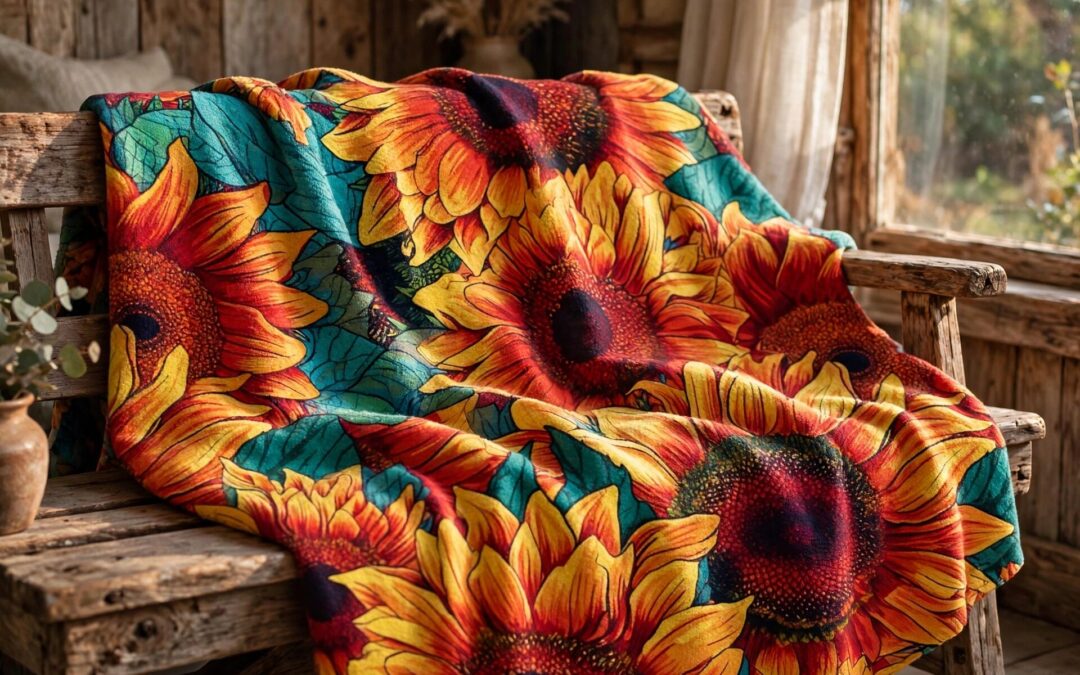
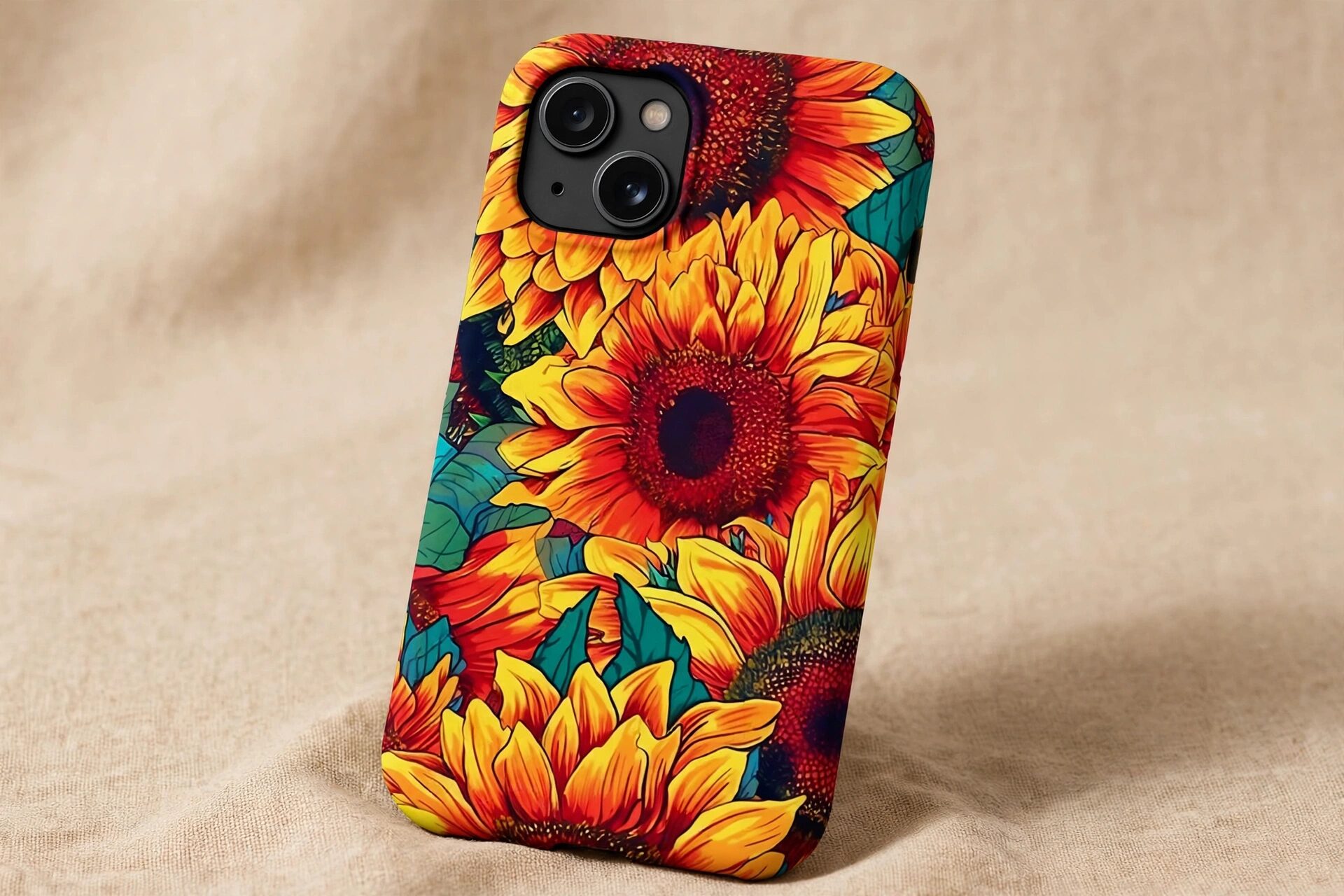
The throw blanket is the truest translation: ember-orange blooms wrapped around shoulders on an October evening, the teal leaves cooling the composition just enough that it comforts instead of overwhelms. It is autumn you can pull over your knees. On a phone case, the fire goes portable — a small daily signal, glanced at a hundred times a day, that says stand tall in the middle of the inbox. The pattern scales beautifully to a wall tapestry (a whole harvest above the mantel), a throw pillow (the exclamation point on a neutral sofa), a tote bag, even an apron — because the kitchen, let’s be honest, is where most of us actually tend our fires.
As one of the founding designs of the Hashola shop, it has been warming rooms for years — one of the twelve originals that proved surfaces could hold this much feeling. The shop has grown into collections and drops and a full journal since, but the fire was there from the beginning. It always is.
On Beginning
One last breath. Close the meditation where the sunflower began: facing east, toward the dawn. The flower spent its youth following the light across the sky. Then one August it understood — the light was never out there. It was in the seed all along, waiting for the season to give it permission.
Permission granted. Sunflowers on Fire is available on throw blankets, phone cases, tapestries, and more — or find your own heat among the full collection at the Hashola Designs shop on RedBubble.
Breathe in. Burn bright. That is the whole teaching.