Before the Tie-Dye: A Thousand Years of Dyed Dissent
Every psychedelic bloom has an ancestor, and the tie-dye flower’s family tree is older than the 1960s by a millennium or so. Long before a hippie ever twisted a shirt into a spiral, dyers in Japan were folding and binding cloth into shibori patterns — the word literally means “to wring” — creating resist-dyed textiles of such intricacy that a single kimono could take a year to finish. In West Africa, the Yoruba perfected adire, indigo-dyed cloth patterned with starch resist, carrying whole proverbs in its designs. In India, bandhani tie-dye adorned wedding saris centuries before “festival fashion” was a phrase anyone said out loud.
All of these traditions share one instinct: that color should not be contained. That dye, left to its own devices in water, will do something the human hand could never plan — bleed, bloom, surprise. The ancients understood what the counterculture would later rediscover: surrender is a technique.
1967: Color Becomes a Protest Sign
Then came the Summer of Love, and tie-dye went from folk craft to front-page news. The hippies didn’t invent the technique — they weaponized it. In an America dressed in gray flannel suits and olive drab, a spiral-dyed tee was not a fashion choice; it was a position paper. It said: I refuse the uniform. I refuse the palette. I will be visible from a quarter-mile away, and I will enjoy it.
The flower became the movement’s logo almost by accident — handed to soldiers at demonstrations, tucked into rifle barrels, painted on foreheads — because the flower was the one thing the establishment couldn’t argue with. You can’t outlaw a petal. And so “flower power” entered the language as shorthand for the whole beautiful, naive, necessary idea that joy itself could be a political act.
The Revival: Why We Never Really Stopped
Here’s the part the history books underplay: tie-dye never actually left. It went through cycles — the mall-goth 90s, the ironic 2000s — but it kept resurfacing because it answers something permanent in us. Every few years, usually when the world feels too gray or too optimized or too doom-scrolled, people start twisting fabric and pouring dye again. The 2020s revival was the biggest yet: stuck indoors, the internet turned tie-dye into a collective art project, and the technique’s perfect imperfection — no two pieces alike, ever — became the antidote to an age of identical screens.
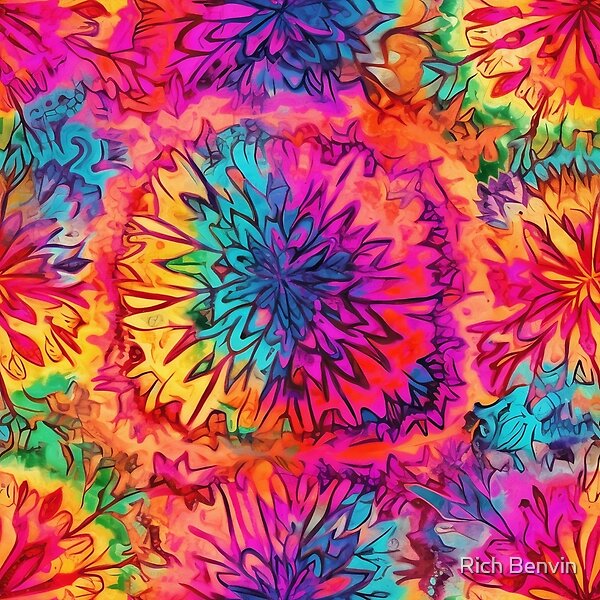
Tie-Dye Flowers is that revival painted at full volume. It is not a shirt that happens to be tie-dyed; it is a bloom caught mid-explosion — hot pink (#FF2E88) detonating outward through magenta (#C9005B), molten orange (#FF7A1A) bleeding into acid yellow (#FFD400), electric teal (#00C2B8) holding the whole kaleidoscope together like a bass line under a guitar solo, all of it grounded in ink violet (#2A0E3F) so the color has somewhere to fall. The watercolor tie-dye washes give it the handmade looseness of real dye in real water; the kaleidoscope structure gives it the symmetry of a flower deciding, all at once, to be magnificent.
Somewhere between the dye and the dream, the flower learned to sing in color.
Color as Rebellion, Joy as Discipline
Look closely and the design carries the whole cultural argument in its petals. The psychedelic floral form says: play is serious. The flower-power composition says: gentleness is not weakness — it is a tactic. And the sheer volume of the color says what every tie-dye revival has said since 1967: you do not have to be quiet to be taken seriously.
This is the meaning of the piece, and it is unapologetic. Freedom, play, and the courage to be loud — not loud as in rude, loud as in alive. In a culture of beige minimalism and curated restraint, wearing a full-spectrum bloom is a small daily refusal. It is the descendant of the spiral tee and the shibori kimono and the bandhani sari, and it carries their shared conviction: that beauty, unleashed, is a kind of power.
Wear the Detonation
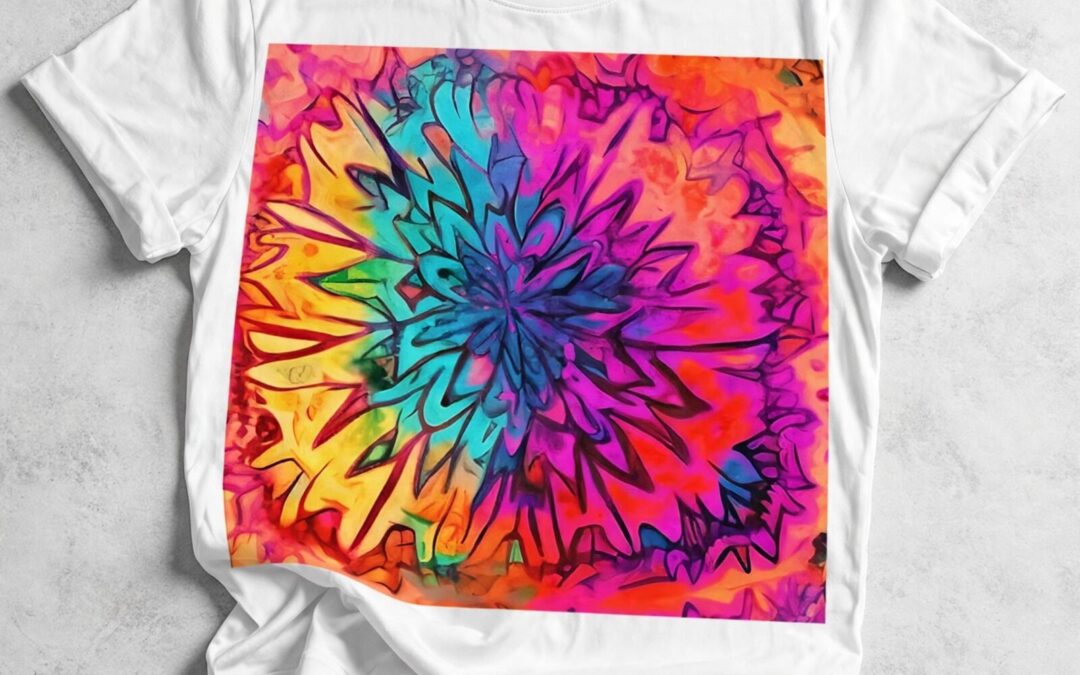
Some designs want to be framed. This one wants to be worn — preferably in motion, preferably outdoors, preferably within earshot of live music. The Tie-Dye Flowers t-shirt is the natural home: the bloom prints huge and unapologetic across the chest, and the ink-violet ground means it survives actual festival conditions — dust, sunscreen, spilled lemonade — with its dignity intact.
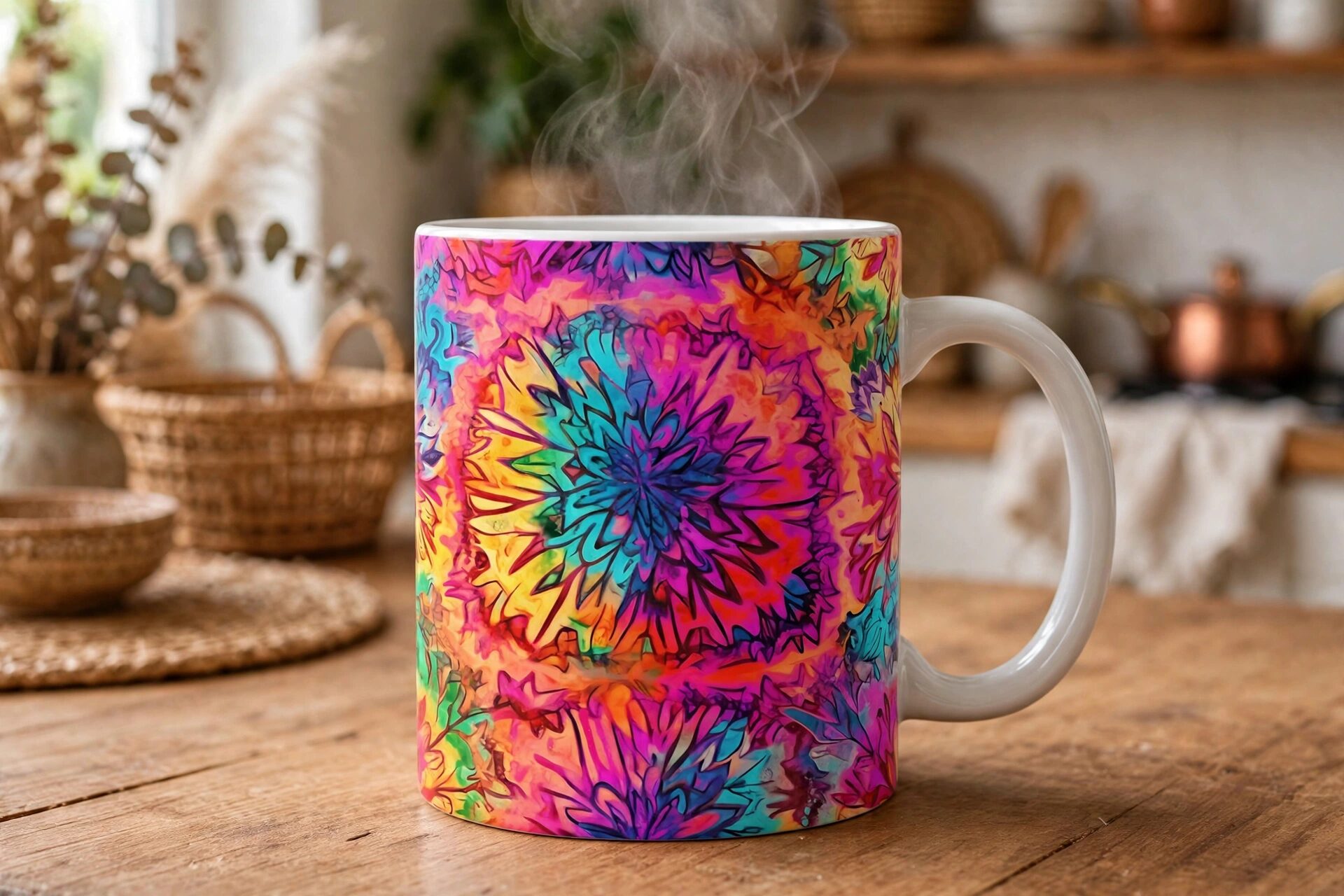
But the design’s second life is domestic, and it’s a good one. On a mug, the kaleidoscope wraps the full circumference — a morning ritual upgraded to a ceremony. On a throw blanket or a wall tapestry, it becomes the room’s exclamation point: the one object guests ask about, the one that makes a rental apartment feel like it belongs to someone with opinions. It lands just as happily on a hoodie, a tote bag, or a phone case — anywhere that could use a little more voltage.
As one of the founding designs of the Hashola shop, it has been selling its particular brand of chromatic optimism for years — long before the current revival, which only proves the point: tie-dye doesn’t follow trends. Trends follow tie-dye, eventually, and then pretend it was their idea.
Join the Bloom
The history of tie-dye is really a history of people deciding, over and over across a thousand years, that the world could use more color than it was issued. The Japanese dyers wringing cloth into shibori stars. The Yoruba speaking in indigo proverbs. The kids in Haight-Ashbury twisting shirts in a bathtub. The festival crowds of last summer, still finding each other by the brightness of their tees.
Tie-Dye Flowers is your invitation to that lineage. Not nostalgia — continuity. The flower learned to sing in color; the least we can do is hum along.
Grab it on t-shirts, mugs, hoodies, and more — or dive into the full archive of color at the Hashola Designs shop on RedBubble. Be loud. The flower is.