
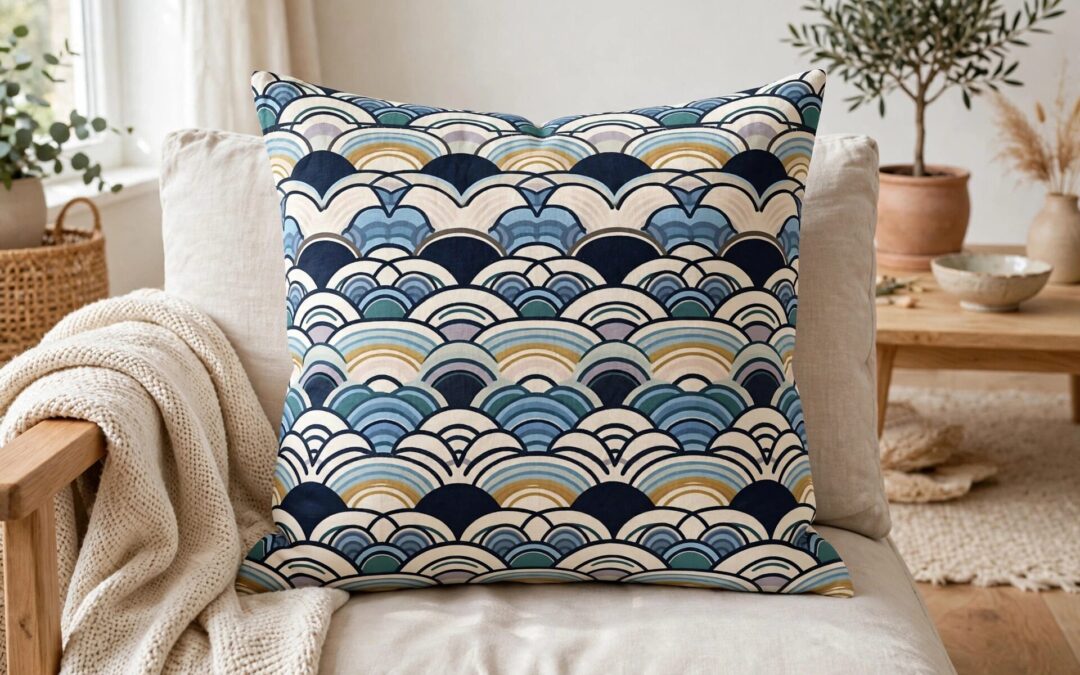
There are patterns that decorate, and there are patterns that mean. The seigaiha — the overlapping fans of ocean wave that roll across this design in deep navy, warm cream, and gilded gold — belongs firmly to the second kind. It is one of the oldest continuously used motifs in Japanese art, and wearing it, hanging it, or simply resting your head against it is to take part in a visual tradition older than most nations.
A Motif Born on Ancient Maps and Kimono
The seigaiha (青海波, literally “blue sea waves”) first appears in the historical record on maps and ceramics of the Asuka period, over thirteen centuries ago. Its geometry is beautifully simple: concentric arcs drawn in staggered rows, each row overlapping the last like the fan of a scallop shell — or, more precisely, like the moment a wave breaks against the shore and the foam curves back on itself.
The name itself comes from an ancient piece of gagaku, Japanese court music, titled “Seigaiha” — “the waves of the blue sea” — danced by an attendant dressed in a robe bearing the pattern. To wear the seigaiha, or to hang it in one’s home, was to dress oneself in the ocean’s blessings: peace, power, and good fortune. It adorned the kimono of nobles, the curtains of shrines, and the packaging of gifts meant to carry wishes of safe passage and long life.
What strikes me about this motif is its quiet resilience. In the great Edo-period woodblock prints, in Meiji-era textiles, in postwar ceramics, in the minimalist interiors of contemporary Tokyo — the seigaiha keeps arriving, wave after wave, century after century. Fashions have burned out around it. It has never once gone out of style. That is not decoration. That is a kind of permanence few human designs achieve.
Why Seigaiha Pattern Still Belongs in Your Home
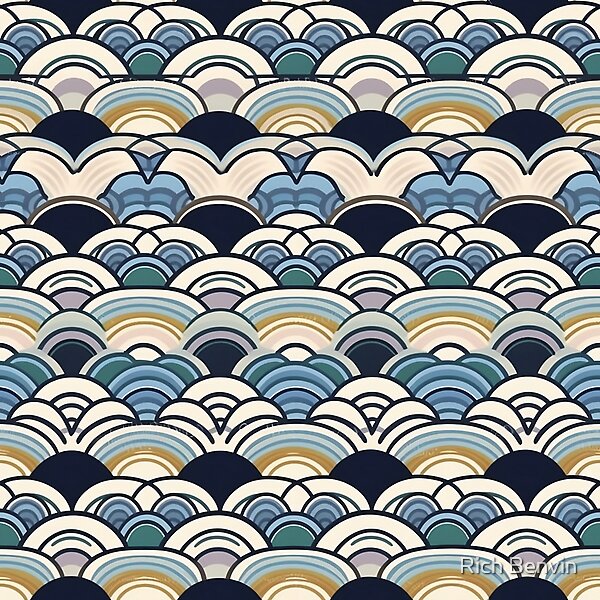
In our Japanese Wave Pattern design, we redrew the classical motif for modern life: overlapping wave fans in deep navy (#1B2A4A), warm cream (#F4EEDC), antique gold (#C9A227), dusty blue (#7FA3B8), and bone (#E8E0C8). The palette is deliberately restrained — it sits as comfortably in a Japandi living room as it does in a beach house, and it speaks in the same calm register as the original kimono weavers intended.
“The sea does not hurry, and yet it is always arriving.”
That line is the design’s whole philosophy. The seigaiha is, at heart, a meditation on rhythm and resilience: the ocean does not force its way anywhere, and yet nothing on Earth escapes its reach. Good fortune, in this tradition, moves the same way — in waves. It comes, it withdraws, it comes again. The pattern is a small daily reminder that persistence outlasts urgency.
The Meaning Woven Into Every Wave
In Japanese symbolism, the seigaiha carries a triple blessing. Peace: the calm sea is the world at rest, the end of storms, the wish for a life unbroken by turmoil. Power: the same ocean that calms also overwhelms; the wave is nature’s strength made elegant and survivable. Good fortune: because the sea returns endlessly, the seigaiha promises that luck, too, will return — that no ebb is final.
These meanings made the motif a favorite for wedding kimono, for New Year’s gifts, and for the garments worn by dancers performing prayers for the nation. When we made this design one of the twelve founding pieces of the Hashola shop, we wanted the first wall of the shop to carry something with gravity — a pattern that has been giving this blessing for over a thousand years.
Where This Wave Belongs in Your Life
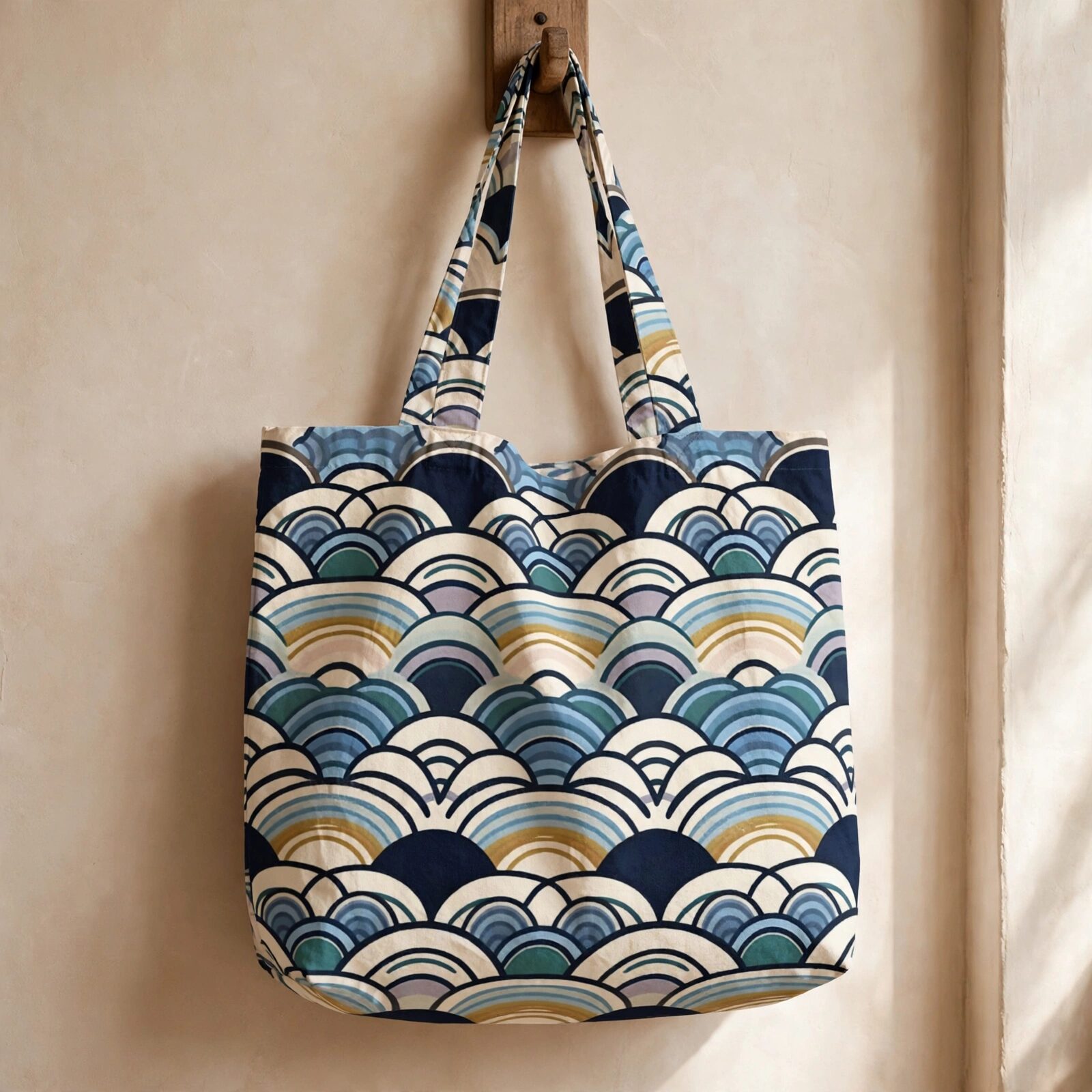
A seigaiha wave throw pillow on the couch turns the room’s loudest piece of furniture into its calmest. The same motif on a seigaiha tote bag becomes a small traveling blessing — an ancient pattern riding the subway with you. On duvet covers and wall tapestries, the repeating arcs do something rare in home decor: they slow the room down.
There is a reason coastal and Japanese-inspired interiors keep returning to ocean motifs. Water patterns are among the few designs that genuinely change how a space feels — the eye follows the rhythm of the arcs, and the mind, almost against its will, starts to breathe with it. Interior designers call this “biophilic rhythm.” The kimono weavers of the Heian court would simply have called it the point.
An Heirloom You Can Actually Live With
One of the quiet tragedies of art history is that the great patterns usually live behind museum glass. The seigaiha has always refused that fate — it was always meant to be touched, worn, sat upon, carried through daily life. This design honors that refusal. It is museum-grade lineage in a form you can spill coffee near.
That’s why Japanese Wave Pattern holds its place among our Shop Classics: it is the founding design that argues art should be used, daily, the way the sea is used — constantly, without ceremony, and always with respect.
Bring the Tide of Calm Home
Explore Japanese Wave Pattern on throw pillows, tote bags, duvets, and wall art — and browse the full founding collection at the Hashola shop on RedBubble. Some patterns decorate a room. This one blesses it.