
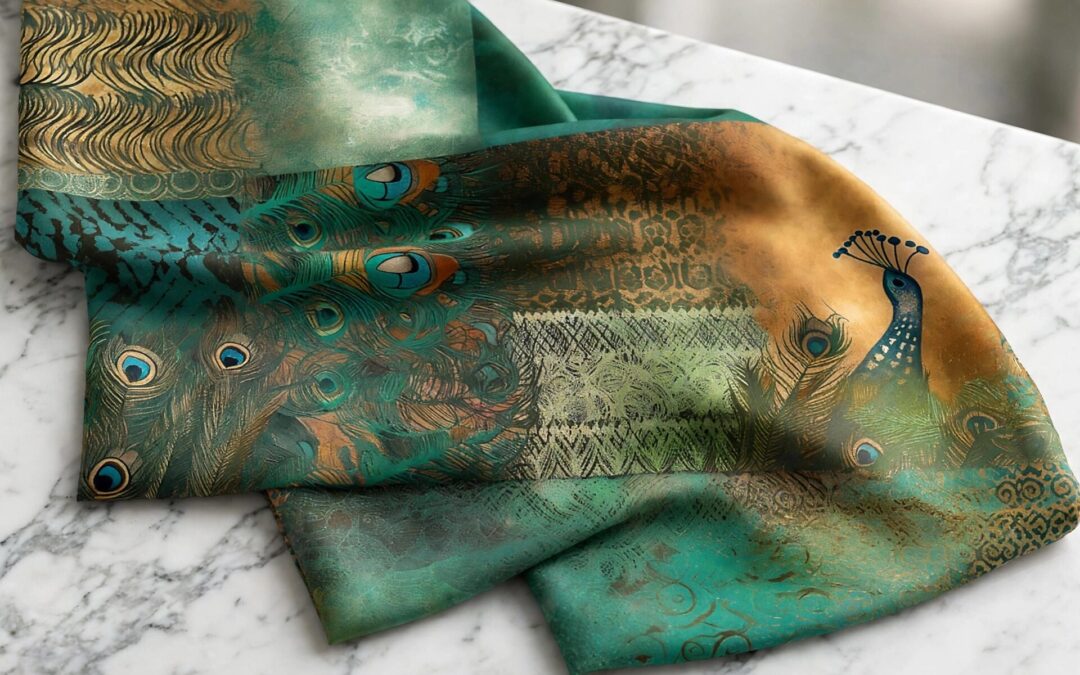
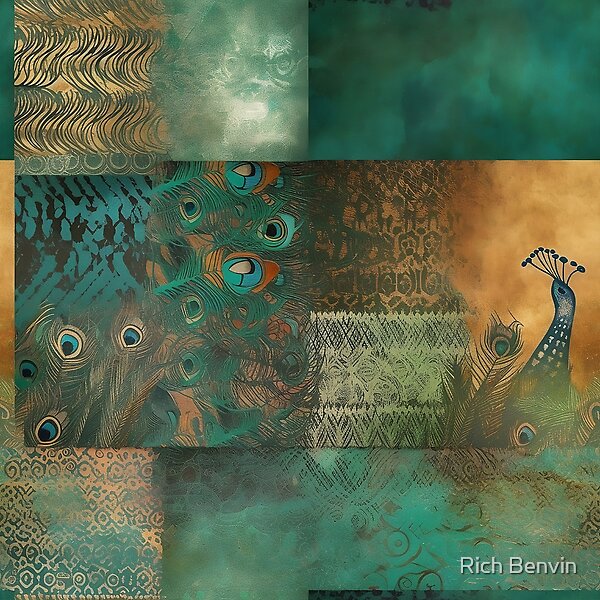
Before you look at this design, close your eyes for a moment and picture a peacock spreading its tail in full sun. There is a reason the image makes your breath catch: no creature on Earth was built more deliberately to be looked at. Peacock Texture takes that moment — the hundred eyes opening at once, each ringed in bronze and gold and drowned-in-sapphire green — and holds it permanently.
This is a collage, not an illustration: feather eyes layered over burnished gold textures, emerald washes, deep pine shadows, aged ivory highlights. It shimmers the way the inside of a treasure box shimmers. And like all the best things the bird has ever symbolized, it refuses to be modest.
Persia: The Bird That Cannot Die
In ancient Persia, the peacock was a creature of paradise — literally. The bird’s association with the garden of the afterlife was so strong that peacock feathers were placed in tombs and woven into funerary textiles as a promise of renewal. There was a folk belief, repeated from Herodotus onward, that peacock flesh did not decay. To the Persian eye, the peacock was proof that beauty could be permanent: immortality you could touch, feathers you could hold.
That belief traveled. It traveled the Silk Road, it traveled on the hulls of trading ships, and everywhere it went the peacock acquired another layer of meaning. But the Persian core never quite left it: this is the bird that outlasts death.
India: Pride Worn Without Apology
In India, the peacock is the national bird and the mount of gods. Kartikeya, the god of war, rides a peacock named Paravani — war itself, the tradition says, should be conducted beautifully. Krishna wears a single peacock feather in his crown, a detail that turns up in thousands of devotional paintings: the feather is humility (it’s light, it’s small) and splendor (it’s impossible to ignore) in a single object.
But the deeper Indian reading of the peacock is about pride — and crucially, pride as a virtue. The peacock does not hide its tail. It does not apologize for being gorgeous. In a world that constantly instructs you to make yourself smaller, the Indian peacock stands up and says: spread. That is the energy this design was built to carry.
Byzantium: The Watchful Eyes of Heaven
When early Christianity inherited the peacock, it kept the Persian immortality and added a new reading: the hundred eyes on the tail became the eyes of heaven, watching over the faithful. Byzantine mosaics are studded with peacocks flanking fountains of life, drinking from the waters of paradise. The feathers’ eyes — those concentric, watchful circles — were read as divine vigilance: beauty as protection.
“Wear the hundred eyes of the peacock; let beauty watch over you.”
Three empires, three meanings — immortality, pride, protection — and they all fit inside a single feather. That is what made the peacock one of our twelve founding Shop Classics: it is the only bird in art history that has never meant anything small.
The Shrine This Design Builds
Our Peacock Texture is a collage in the truest sense: we layered the feather eyes over textures of aged bronze and gold leaf, washed them in emerald teal (#0E6B5C), jade (#1C7A6F), and deep pine (#0B3B36), and lit the whole thing with antique bronze (#8A6D3B), gold leaf (#D4A94E), and aged ivory (#E8DCC8). The result is less a picture of a peacock than a shrine built to one — the way a jewel box is built to hold jewels.
Look closely and you’ll see the art nouveau ghost in it: the whiplash curves, the obsession with the organic, the conviction that pattern itself can be a kind of prayer. The Vienna Secession would have recognized this instinct immediately. The Byzantine mosaicists would have too.
Opulence You Can Actually Wear
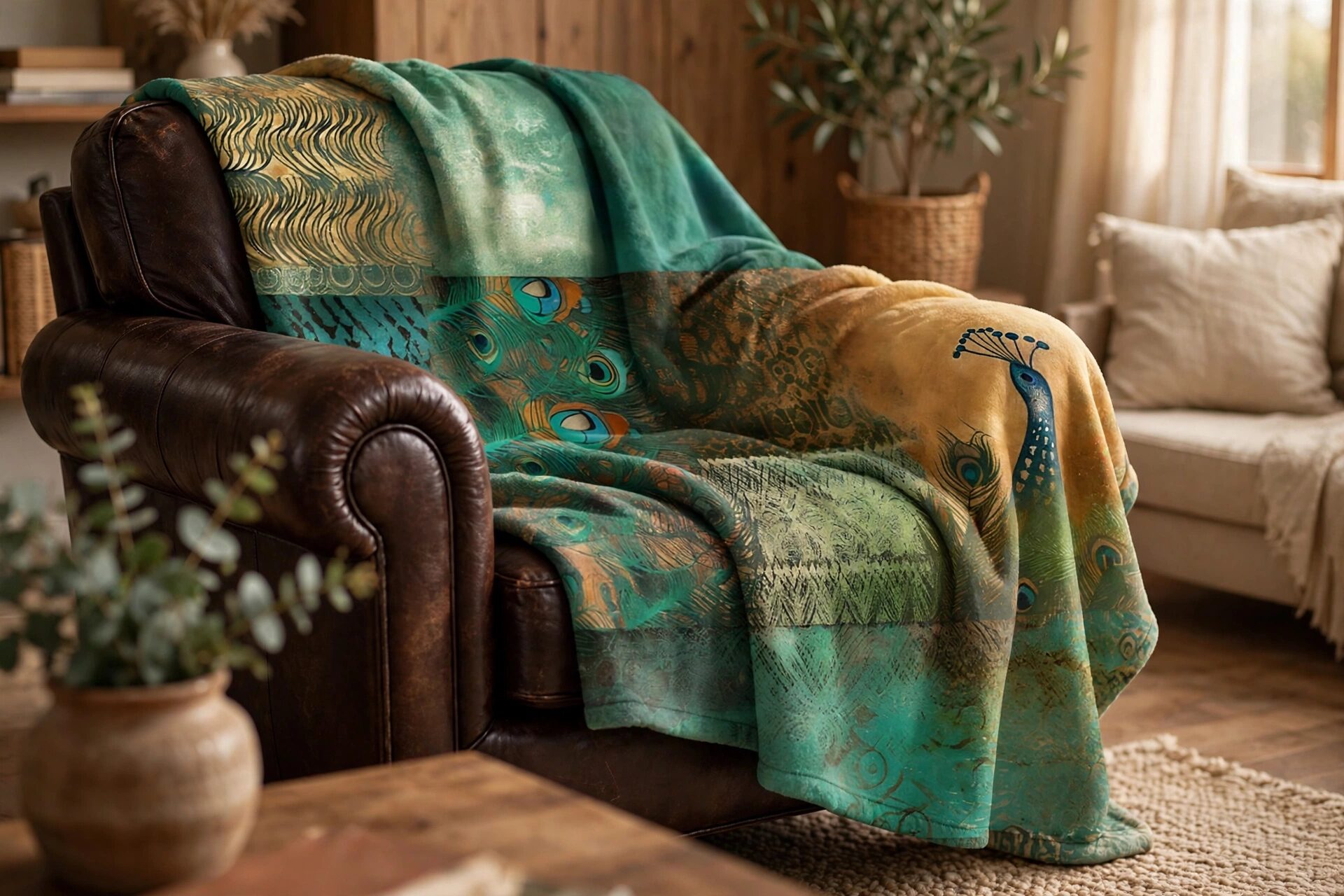
A peacock-feather scarf is one of the oldest power garments in the world — and the peacock scarf version of this design carries that history onto your shoulders. A peacock throw blanket in emerald and gold turns a neutral couch into a throne room. And on a phone case or tote bag, the feather eyes do the work the Byzantines always trusted them to do: they watch over you, visibly, beautifully.
This is maximalist decor with a lineage — the kind of richness that doesn’t apologize for itself because it has three thousand years of empires backing it up.
Wrap Yourself in Jewel-Toned Luxury
Explore Peacock Texture on scarves, throw blankets, totes, and more — and see the rest of the founding collection at the Hashola shop on RedBubble. Some designs whisper. This one watches over you, in a hundred eyes of gold.